
Overview
Corvus Express is a fictional logistics company based in Louisville, Kentucky that uses trained ravens to deliver messages in environments where drones cannot operate due to restricted airspace, dense urban infrastructure, or difficult terrain.
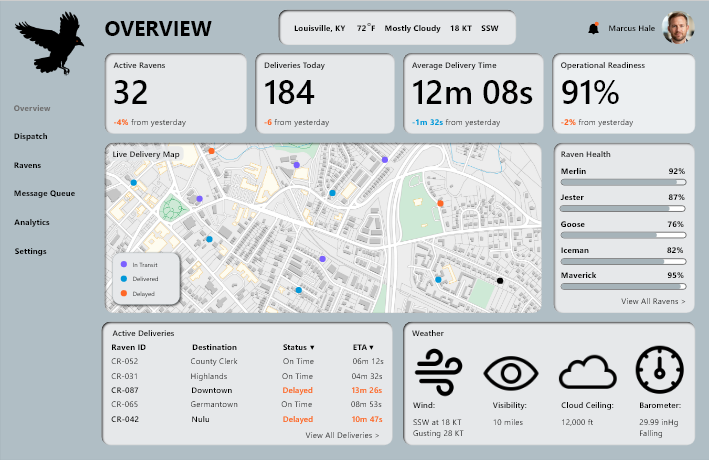
I designed a desktop operations dashboard that helps dispatch coordinators manage deliveries, monitor raven readiness, organize delivery requests, and evaluate operational performance in real time.
The goal was to create a complex operational system that felt realistic while remaining intuitive, scalable, and easy to navigate under pressure.
Role: UX/UI Designer
Tools: Adobe XD, Freepik
Problem / Need
Logistics dashboards often overwhelm users with excessive data, fragmented systems, and poor visual hierarchy slowing decision-making, increasing cognitive load, and limiting visibility into critical operations. For Corvus Express, this challenge was compounded by the need to monitor both active deliveries and the readiness of live delivery assets. The core challenge was balancing operational complexity with speed, clarity, and usability.
Key Insights
1. Dispatch coordinators need immediate access to critical information, not more data. This insight shaped the platform’s hierarchy and reduced unnecessary visual noise.
2. High-pressure logistics environments require interfaces optimized for rapid scanning and low cognitive load.
3. Managing live delivery assets introduced unique operational variables, including health monitoring, route readiness, and availability tracking.
4. Dispatchers need both real-time operational visibility for immediate decisions and analytics for long-term planning.
5. A believable system required realistic workflows, geographic references, and operational constraints.
Design Process
I began by creating a persona for Marcus Hale, a Senior Dispatch Coordinator who relies on real-time systems to make rapid operational decisions. His primary need became the foundation of the platform: “I don’t need more data—I need the right data, in the right place, at the right time.” This directly influenced how information was prioritized across the dashboard.
To create a scalable system, I mapped the full operational workflow before designing individual screens:
Monitor → Assign → Manage → Execute → Evaluate
This led to five core pages:
- Overview
- Dispatch
- Ravens
- Message Queue
- Analytics
To make the platform feel realistic, I incorporated Louisville-specific delivery zones, aviation/weather data, and health monitoring for raven assets.
Visually, I used a minimal neumorphism-inspired interface built around:
- Muted neutral surfaces
- Strategic accent colors
- Grid-based layouts
- A 4-point spacing system
Final Solutions
The final dashboard was designed to reduce operational friction by surfacing critical information at the moment dispatchers need it most. Rather than forcing users to navigate fragmented systems, Corvus Express centralizes real-time operations into a unified workflow that supports both immediate action and long-term performance tracking.
Key design solutions included:
- A real-time Overview dashboard that surfaces deliveries, weather conditions, and raven health in one location
- A dedicated Dispatch system that allows coordinators to assign deliveries, monitor routes, and respond to disruptions quickly
- A Ravens management page that tracks the health, readiness, and availability of live delivery assets
- A structured Message Queue that organizes incoming requests by urgency and operational priority
- An Analytics dashboard that helps leadership evaluate long-term delivery performance trends
By separating high-priority operational tasks into clear workflows, the platform reduces cognitive load while allowing dispatchers to make fast, informed decisions.
Outcome & Reflection
Corvus Express challenged me to design beyond individual screens and think in terms of workflows, operational systems, and scalable architecture. The biggest success of the project was transforming a highly unconventional concept into a platform that feels structured, believable, and usable under pressure. It required balancing real-time decision-making, information hierarchy, and operational realism without overwhelming the user.
This project strengthened my ability to simplify complex systems, design for high-pressure environments, and build interfaces that prioritize speed and clarity. The biggest takeaway was learning that creativity only works when supported by functional realism. A concept can be unconventional, but the user experience must still feel intuitive and credible.
Next Steps:
- Expand interactive prototyping
- Refine analytics visualizations
- Test workflows with logistics professionals